Stop Parenting from Fear: How to Actually Assess Risk (Without Losing Your Mind)
May 21, 2026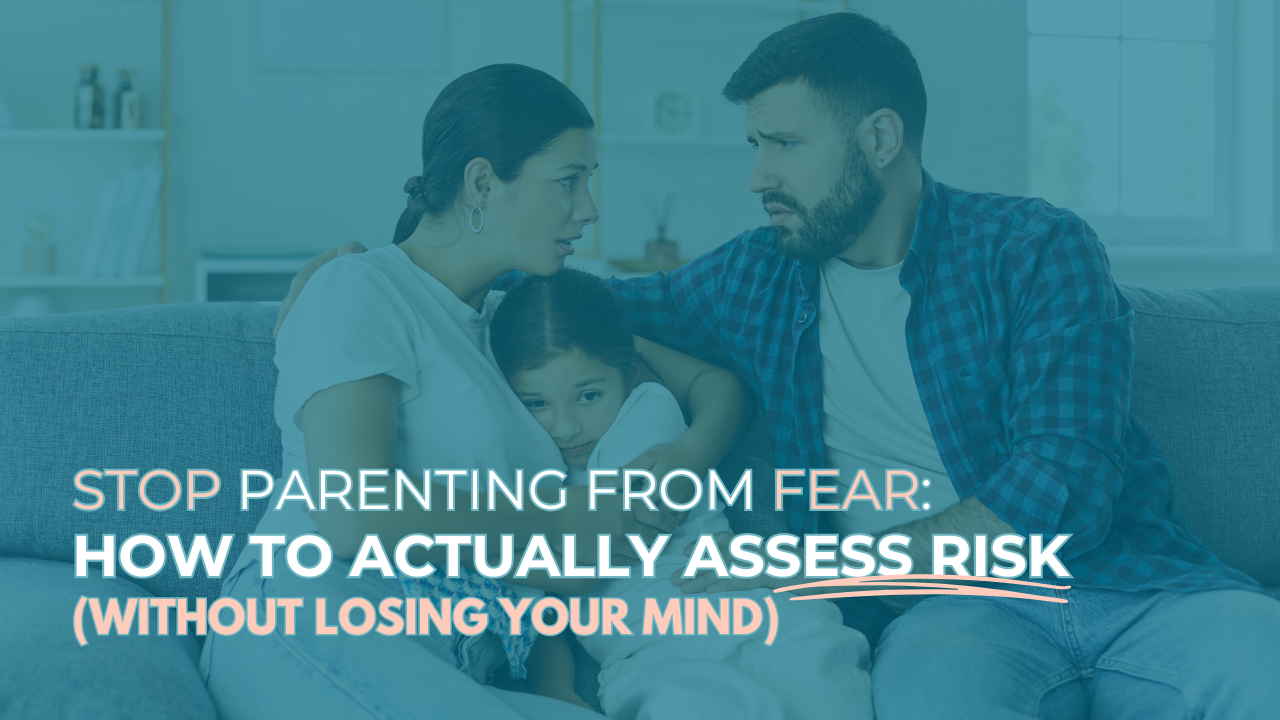
Can my child go to a sleepover? Is it safe to send them to daycare? Should I let them online? Can I post a photo of them on social media?
These are the questions keeping parents up at night. And I get it - the world feels scarier than ever. The headlines are relentless. The warnings are constant. And the pressure to protect your child from every possible threat is absolutely exhausting.
But here's what I've noticed in my years as a detective, as a specialist child interviewer, and as a mum: fear without a framework leads to paralysis. And paralysis doesn't protect your kids - it just makes you feel terrible while you try to make impossible decisions.
So today I want to give you something practical. Something I actually used in my own life - both as a detective assessing risk and as a parent trying to raise a capable, safe kid.
I call it Kristi's Risk Checklist. (Or the KidSafe Risk Check, or the Parent Risk Filter - whatever name makes you want to actually use it.)
Here's what I know to be true: you have more control than you think. And once you feel in control, the fear starts to shift.
First, let's talk about fear - and why it's making things worse
Fear is a normal, healthy response to danger. It exists to protect us. But when fear becomes the default lens through which we parent, it stops being useful and starts being destructive.
Fear-based parenting looks like this:
- Saying no to everything because something bad might happen
- Researching worst-case scenarios until 2am
- Hovering so close your child never gets to try, fail, or learn
- Avoiding conversations about risk because it feels too scary to go there
The problem? Children who are never exposed to manageable risk don't learn how to navigate the world. They don't build the skills, the confidence, or the resilience they need to keep themselves safer.
Risk is not the enemy. Unmanaged, unacknowledged risk is.
And this is where the checklist comes in.
Understanding your options when risk exists
Before we get to the checklist itself, I want you to understand something really important: when you identify a risk, you don't just have one option. You actually have three.
Option 1: Reduce the risk
You keep the activity or situation but take steps to minimise the chance of harm. You change something - the environment, the supervision, the knowledge your child has going in.
Option 2: Remove the risk entirely
You decide the risk is too high and you remove the situation altogether. Sometimes this is the right call. But it's worth asking: what does your child lose if you do this? What experience, independence, or skill development gets cut off?
Option 3: Proceed with protective measures
You go ahead knowing the risk still exists, but you don't go in blind. You put protective measures in place - conversations, check-ins, safety plans, knowledge - and you trust your child with the information they need to navigate it.
Most good decisions land in Option 1 or Option 3. Very rarely is Option 2 the best long-term choice for a child's development and safety literacy. But sometimes it is - and that's okay too.
When you're faced with a decision about your child's safety, work through these eight questions. You don't need a spreadsheet. You just need to slow down and think it through.
Kristi's Risk Checklist1. What is the actual risk here - what could go wrong? 2. How likely is it that this will happen? 3. What is the potential harm if it does? 4. What control do I have over this situation? 5. Can I reduce the risk? How? 6. Can I remove the risk entirely? What would that cost my child? 7. If I proceed, what protective measures can I put in place? 8. Is my child equipped with the knowledge and skills to keep themselves safer? |
That's it. Eight questions. And once you've worked through them, you make your call - not from panic, but from an informed place.
Let's see how this plays out in real life scenarios.
The checklist in action: real scenarios
|
Scenario 1: The Sleepover Your 9-year-old has been invited to sleep over at a school friend's house. You've met the parents a couple of times but don't know them well. Your child is desperate to go. Working through the checklist: What is the actual risk? Unsupervised access by adults, potential exposure to inappropriate content, or situations your child isn't equipped to handle. How likely is it? Low - most sleepovers are completely fine. But likelihood doesn't mean zero. What is the potential harm? Could range from minor (bad night's sleep, junk food) to significant depending on the environment. What control do I have? Plenty. You can meet the parents properly beforehand, ask about supervision, set a check-in time, and ensure your child knows they can call you any time without question. Can I reduce the risk? Yes - have the conversation with the parents, arrange a brief daytime visit first or a 'sleep out' instead (pick up before bedtime so they have the sleepover experience without the whole sleepover) and make sure your child has body safety language and knows they can tell you anything. What does removing the risk cost? Your child misses out on the potential social connection, independence, and the experience of navigating new environments. Note: Depending on your beliefs and values, you may not find this an issue but you also may not be willing to risk it. What protective measures? Brief your child beforehand. Review body safety rules. Give them a code word they can text you if they want to come home, no questions asked. Confirm pick-up time. Is your child equipped? This is the key question. If they have the language, the trust in you, and the knowledge - they're far better placed to handle whatever comes up. Decision: Potentially proceed with protective measures in place. This is considered a normal childhood experience and you can allow it if the other family meets the expectations. If not, find a work around solution. |
|
Scenario 2: Social Media and Posting Photos You want to share a cute photo of your child on your personal Instagram. They're in their school uniform. You're wondering if it's safe. Working through the checklist: What is the actual risk? The photo could be seen by people outside your intended audience. Location or school could be identifiable. In rare cases, images are misused. How likely is it? If your account is public, higher. If it's private with vetted followers, much lower. What is the potential harm? Identity of school revealed; image saved and misused especially now with AI; your child's digital footprint built without their consent. What control do I have? Significant. Account privacy settings, removing school uniform or location identifiers, cropping out context clues and posting an abstract artsy photo instead. Can I reduce the risk? Yes - switch to a private account, change into different clothes for photos, avoid posting locations, check your tagged settings. Can I remove the risk? Yes - don't post. But this might feel like an overcorrection for your situation or it might be that you don't think it's worth the risk. Neither is wrong and is completely based on your values and beliefs. What protective measures? Private account, no uniform, no location tags, watermark if sharing publicly. Consider sharing in a private message to family members directly. Also consider: is your child old enough to have an opinion about this? Ask them. Is your child equipped? Teach them about digital footprints early. Discuss who you are sharing the photo with and why. This is an ongoing conversation, not a one-off. Decision: Reduce the risk. A few simple adjustments let you share normal family moments without unnecessary exposure. |
|
Scenario 3: Letting Your Child Go Online Your 11-year-old wants to play an online multiplayer game with their school friends. You've heard stories about online predators and you're not sure. Working through the checklist: What is the actual risk? Exposure to strangers, inappropriate content, potential grooming contact, cyberbullying. How likely is it? Some risks are common (inappropriate language, peer conflict). Others (grooming) are common but serious and should be considered. What is the potential harm? Emotional distress at the low end; exploitation at the high end if no protective measures exist. What control do I have? A lot. Device settings, game platform parental controls, where the device is used (common areas vs bedroom), who they're allowed to play with. Can I reduce the risk? Yes - set up parental controls, keep devices in common areas, have them play only with known friends, review friend requests together. What does removing the risk cost? Potential social exclusion. At 11, online gaming is a significant part of peer culture. Isolation has its own risks but it's not the end of the world. What protective measures? Gaming in shared spaces. Regular check-ins about who they're talking to. Clear rules about accepting strangers. Open-door policy for anything that feels weird. Is your child equipped? Do they know what grooming looks like? Do they know they can come to you without being in trouble? That's the non-negotiable. Decision: Potentially proceed with strong protective measures. The goal isn't to keep them off the internet forever - it's to make sure they know how to navigate it safely. |
The real point here
You'll notice that in every single scenario, the answer wasn't 'no.' It wasn't 'ban everything.' And it wasn't 'don't worry about it, it'll be fine.'
It was: think it through, put measures in place, and equip your child.
Because here's what I know from thousands of hours spent inside the worst-case scenarios - the ones I investigated as a detective:
|
The families who were most protected weren't the ones who locked everything down. They were the ones whose kids knew they could talk to them. They were the ones who'd had the uncomfortable conversations early. They were the ones who had given their children language, knowledge, and trust - not just rules. |
Safety doesn't come from fear. It comes from preparation.
One more thing: risk is actually good for kids
I know that sounds counterintuitive. But children who are allowed to take age-appropriate risks - physical, social, emotional - develop better judgement. They learn to read situations. They build confidence in their own instincts.
When we remove every risk from a child's life, we don't create safety. We create kids who don't know how to handle uncertainty and uncertainty is inevitable.
Your job isn't to eliminate risk. It's to help your child learn to navigate it.
And you're more equipped to do that than you give yourself credit for.
I spent many nights wondering if a scenario or situation was safe for my own daughter to do when she was younger - and when I couldn't manage the risk, it was a 'no' - but I always tried to find ways to minimise or remove the risk before I did that.
Use the checklist. Trust yourself.
The next time you're frozen in front of a decision - sleepover, screen time, school camp, photo, sport, whatever it is - come back to these eight questions.
Work through them. Slowly. Without your phone in your other hand or a browser tab full of worst-case scenarios.
And then make your call. Not from fear. From information.
That's what I did as a detective. That's what I did as a mum. Sometimes the answer was still a 'no' but when I made the decision it was from a place of knowledge and empowerment. I knew why I was making my decision and it helped me hold my values and stay strong.
It's what I want for every parent reading this.
|
Save this. Share it. Use it. And if you want help having the bigger conversations with your kids - about bodies, boundaries, online safety, and what to do when something feels wrong - that's exactly what I'm here for. Check out the rest of my website for resources, guides, and the Conversations with Kids Body Safety Card Deck. www.conversationswithkids.com.au |

